Personalized cold email examples, real and torn down
Teardowns · Updated July 2026
Most collections of cold email examples are templates, and copying a template is how you end up sounding like everyone else who copied it. This page tears down one real send from the week driftwood (driftwood.sh) ran outbound for Autosana (YC S25), next to the templated patterns it beat. Every example is labeled: the real one is shown as it went out, identities redacted; the bad ones are composites we wrote to show the patterns, with no real sender quoted.
What makes an example worth copying
You cannot copy the words. You can copy the work.
Why examples pages exist. People search for cold email examples wanting words that already worked somewhere else. The words are the one part that does not transfer: a first line that got a reply was true about one company on one day, and pasting it into another thread makes it false.
What actually transfers. The shape underneath the words: what the sender went and found, what the message shows instead of claims, how small the ask is, and how little else there is. Those four things can be copied for any prospect, and they are what every teardown below annotates.
How this page labels things. One example on this page is real: a send from the Autosana week, shown with the same redactions as the case study. The bad examples are composites we wrote to show the patterns. Every window says which it is, because an examples page that fakes its examples has already failed its own test.
the template pattern (composite, written by us)
quick question
Hey ,
Hope you're doing well! Huge fan of what you're building, truly impressive momentum.
I'm with an AI-powered QA platform, the all-in-one way to ship faster with confidence. Teams like yours are seeing huge results and we'd love to show you how.
A few things teams love:
- Cut regression time by up to 90%
- Seamless integration with your existing stack
- Enterprise-grade security (SOC 2 Type II)
Any chance you have 15 minutes this week? You can grab time here.
Best,
SDR @
P.S. Happy to send over a case study if that's easier!
Left on opened.
what driftwood sent (real, redacted)
4 months of outreach, no reply
Jul 9

hey , found a bug on . our agents caught your pricing page still promising early access for features lower tiers already have…
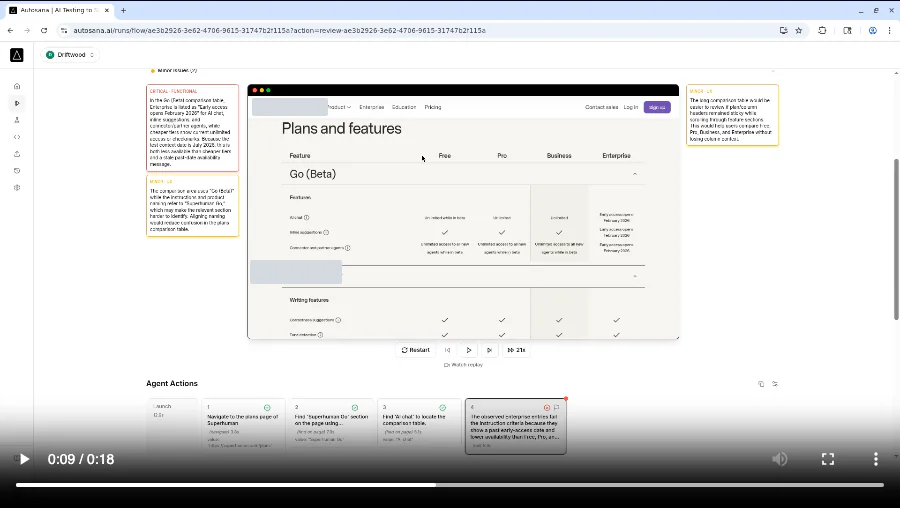
driftwood built this demo
Jul 10 · 12 hours later
send me a blurb + demos to and I'll forward to my team - best
Call booked · Jul 12
The left window is a composite: we wrote it to show the pattern, and no real sender is quoted. The right window is a real send from the Autosana week, identities redacted the same way the case study redacts them.
The real send, torn down
One message ended 4.5 months of silence in about 12 hours.
The thread, in one paragraph. This example is real. A CTO whose company we do not name had ignored 4.5 months of outreach from Autosana founder Yuvan Sundrani; the first message went out February 26, 2026 and was never answered. On July 9 the driftwood agent sent the message in the right window above. The CTO replied in about 12 hours, asking for a blurb and demos he could forward to his team, and the call was booked July 12. The dates and the thread as it happened are on the Autosana case study.
The first line: a found fact. "Found a bug on your site" is not a compliment or a category claim; it is a report. The agent had caught the prospect's pricing page still promising early access for features lower tiers already had. No merge field produces that line, the reader can verify it in one click, and that is what makes it safe to open with.
The attachment: proof of work. The 19 second video shows Autosana's agent catching that bug on the prospect's own site. It answers the question every pitch eventually faces, would this work on us, before it is asked. The message does not claim a demo would be worth his time; it includes the demo, and 19 seconds is short enough to watch between meetings.
The ask: nearly none. There is no calendar link and no "15 minutes this week". The message shows the work and stops, and the CTO supplied the next step himself. An ask that small travels further than any booking link, because replying costs the reader nothing he did not offer.
The length: under 30 words. Everything a longer email would have added, the company intro, the feature list, the logos, is replaced by the video. Short is not the trick here; short is what is left when the message has one thing to show.
Where this example comes from. Plainly: the real example on this page is driftwood's output, which is why we can show it. driftwood is an AI sales agent for demo-led outbound: for each prospect the agent does the research, builds a working demo of your product for that prospect's business, and drafts the message, and a human approved this send before it left Yuvan's own account.
Reply rate before
under 1%
Reply rate, week one
over 14%
On the same lead list, replies went from under 1% to over 14% in week one at Autosana (YC S25). The full story, with dates and the review queue, is the case study.
The slop patterns to avoid
Three composites, written by us. Each one is labeled, and no real sender is quoted.
Why composites. These are the patterns a B2B inbox sees daily. We wrote each one ourselves rather than pasting a real person's email under a teardown: they are illustrative, not received. The left window above shows the family; these are the three patterns inside it, one at a time.
The merge-tag template
Composite 1 of 3 · illustrative, written to show the pattern
Quick question, {{first_name}}
Hi {{first_name}},
I noticed {{company_name}} is doing impressive work in {{industry}}. Teams like yours often struggle with {{pain_point}}, especially as you scale.
That's where {{product_name}} comes in. We help companies like {{competitor_1}} and {{competitor_2}} {{value_prop}}.
Worth a quick chat {{day_of_week}}? Here's my calendar: {{booking_link}}
Best,
{{sender_first_name}}
Deleted on sight; the next send from this domain goes to spam.
The tell. Fill the braces and it reads smoothly, and that is the problem: every sentence survives swapping in any other company. The personalization is a database column, so the reader's filter, could this exact message have gone to anyone else, returns yes on every line.
Why we show the braces. This is the left window above before the merge runs, which is how the sender saw it. The sender's view is the tell: if the only parts of your message that change per prospect live in the braces, nothing in it required looking at the prospect.
What would fix it. Nothing inside the template. The fix happens before writing: finding one thing about one company that took effort to find. That is the entire difference between this window and the real one above.
The fake-personal first line
Composite 2 of 3 · illustrative, written to show the pattern
congrats [first name]!
Hey [first name],
Congrats on the Series A! Really impressive milestone. Also loved your recent LinkedIn post, it resonated with me.
Anyway, the reason I'm reaching out: I'm with an AI-powered analytics platform that helps teams like [company] turn their data into decisions.
Would love to connect for 15 minutes this week!
Read to the second line, filed as a campaign.
The tell. The first line mentions the prospect without containing them: the raise is public news, and "your recent post" never says which post. Sequencers generate both automatically off funding announcements and profile scrapes, and the pivot word "anyway" marks where the template resumes.
Why it fails. The reader sends outreach too. Manufactured familiarity does not read as neutral; it reads as a tool they can name, and it burns the one line that decides whether the rest gets read.
The repair. A first line has to hold a finding, not a compliment. "Found a bug on your pricing page" survives the could-this-go-to-anyone-else test; "congrats on the raise" fails it.
The essay
Composite 3 of 3 · illustrative, written to show the pattern
Partnership opportunity: [our company] x [company]
Hi [first name],
My name is [sender] and I'm the co-founder of [our company]. We started the company in 2023 after living this problem ourselves at our last startup, and we've been heads-down building ever since.
[Product] is an end-to-end platform for [category]. A few highlights:
- AI-driven workflows that save your team hours every week
- Seamless integrations with your existing stack
- Enterprise-grade security and compliance
We already work with teams at [logo], [logo], and [logo], and I think [company] could be a great fit. I'd be happy to walk you through a case study from a company in your space.
Do you have 20 minutes this week or next? Alternatively I can send over a one-pager and a deck, whatever is easiest.
Looking forward,
[sender]
Skimmed to the bullets, never finished.
Count what it covers. The sender, the founding year, the origin story, the category, three features, three logos, a case study offer, and two asks. The recipient appears twice, both times as a merge slot; nothing in the message required looking at the company it went to.
Length is the symptom. The usual fix, keep it under 100 words, would produce a shorter message about the sender. The real problem is direction: the message faces the wrong way. The real send above spends its only lines on the prospect's own site and lets the video carry the rest.
Two asks get neither. "20 minutes" and "I can send a deck" are two exits, and given both, most readers take the cheaper one; a deck sent is usually a thread ended. The mechanics of asks, length, and first lines are covered in the how-to register on the B2B SaaS outreach guide.
Proof of work, generalized
What to build when you cannot attach a working demo.
The principle, restated. The real example works because the message carries evidence of effort spent on one prospect, not because of its word choice. Anything you can build that a template cannot fake plays the same role. Four that work, in rough order of strength:
A found bug. The Autosana pattern by hand: use the prospect's product the way a new customer would and write down where it breaks. A broken signup flow, a stale pricing page, a docs link that 404s. The first line writes itself, and the reader can verify it in one click.
A recorded walkthrough. A short screen recording of you inside their product or docs, narrating what you noticed: a Loom of their flow rather than a deck about yours. It proves a human spent the minutes, which is the entire signal.
A mockup. Their page or their flow with your change applied, a before and after. It moves the conversation from imagine this to here it is, and it survives being forwarded to the person who actually decides.
A spreadsheet. Their public numbers assembled into something useful: their pricing against three competitors, their job posts mapped to the gap you fill, their app store reviews sorted by complaint. Unglamorous, and it reads as hours spent, because it was.
The cost, plainly. Each of these takes half an hour to a few hours per prospect, and that is not a flaw in the pattern; it is the pattern. The reply rate lives in effort the prospect can verify, and effort that can be verified cannot be faked cheaply. When the hours run out, that is a capacity problem, not a copy problem.
Where the how-to lives. This page shows examples. The writing mechanics around them, subject lines, first lines, length, follow-ups, and when to stop, are the B2B SaaS outreach guide; the two pages are meant to be read together.
FAQ
Four short answers.
What is an example of a personalized cold email that actually got a reply?
The real one on this page. A two-line message that opened with a bug found on the prospect's own site and carried a 19 second video of the sender's product catching it. It got a reply in about 12 hours from a CTO who had ignored 4.5 months of prior outreach. The thread, redacted, and the dates are on the Autosana case study.
Can I copy these cold email examples word for word?
No, and not because of us. The words stop working the moment they are copied: "found a bug on your site" only works if you found a bug on their site. What copies is the shape: a found fact first, proof of work attached, and an ask so small it barely exists.
Why are the bad examples composites instead of real emails?
Because a teardown needs no victim. Quoting a real bad cold email would put a real person's name, or a thin redaction of it, under a teardown, and the patterns are common enough that nothing is lost by reconstructing them. Every window on this page is labeled: the good example is real and redacted, and the bad ones are written by us.
What reply rate should cold emails like these get?
The public studies split by effort. At scale and average quality, measured replies now sit under 1%: Belkins measured 0.45% across 7.5 million sends. Small, heavily researched campaigns measure between 5% and 18% in the public studies, with advanced personalization at roughly 17-18% in Woodpecker's data. The studies, with links, are on the cold outbound benchmarks page.
See a demo built for your business
The real example above was built by an agent. Twenty minutes, and we will show you what your prospects would see.
Book a demo