B2B SaaS outreach: how to do cold outbound in 2026
Guide · Updated July 2026
B2B SaaS outreach is cold outbound where the buyer is a software company, and usually so are you. This is a practical guide for founders and early growth hires running it themselves: targeting before copy, how to write the messages, what proof-of-work outreach looks like, and the funnel numbers to plan on.
What makes B2B SaaS outreach different
Your prospect runs outbound too, and filters accordingly.
Who you are writing to. In most industries, cold outbound competes with other salespeople. In B2B SaaS it competes with people who run outbound themselves. Your prospect is a founder, an engineer, or an operator at a software company; they have sent cold email, and they recognize the templates, the merge tokens, and the manufactured familiarity, because they have used them.
What AI changed. AI writing tools made this worse. A researched-sounding sequence now costs nothing to produce, so a SaaS buyer's inbox is full of messages that mention their company and say nothing about it.
The filter. The result is a filter those buyers now run by default: could this exact message have been sent to anyone else? If yes, it gets deleted, usually without being consciously read.
The way through. That filter is the constraint the rest of this page works around. Nothing below is a trick for getting past it. The only reliable way through is a message that could not have been sent to anyone else. That is expensive to produce, which is exactly why it works.
Targeting before copy: ICP, list quality, bounce hygiene
Most failed campaigns die in the list, not the copy.
The order. Most outbound advice starts with the email. Most failed campaigns die earlier than that, in the list. Work in this order, and do not skip ahead.
Define an ICP narrow enough to change the message. Stage, team shape, and the trigger that makes your problem current for them this quarter. The test: reading the ICP tells you what the first line of the email should mention. If it does not, it is a market description, not an ICP.
Verify every address before it enters a campaign. Database exports and scraped lists decay fast. Keep bounces under 2%; above that, stale addresses damage sender reputation, and every later send pays for it. The thresholds and the studies behind them are on the cold outbound benchmarks page.
Fix deliverability before touching copy. A reply rate means nothing if the emails sit in spam. If replies are under 1%, work the diagnostic order on the benchmarks page: bounce rate, then a placement test, then and only then the copy. Most sub-1% campaigns are a list or deliverability problem, not a copy problem.
Small and specific beats large and plausible. For SaaS specifically, a hundred companies that match the trigger will out-reply a thousand that match the industry code, and the smaller list is the only one a founder has time to research properly anyway.
How to write a cold email subject line
Two to four plain words, and no cleverness.
Short, specific, and plain. Two to four words that name the thing the email is about: "your onboarding flow", "the checkout bug", "QA without a QA team". The subject line has one job, which is to not look like a campaign. Internal email has plain subjects, so plain subjects get opened.
The campaign signals. Clever subjects, questions with the prospect's first name in them, and fake "Re:" threads are all campaign signals now, and your prospect sends campaigns for a living.
Do not optimize for opens. Open tracking has been unreliable for years, which is covered on the benchmarks page. Write the subject for the person who will already open it, as the label above your first line in the inbox preview.
How to start a cold email
With the observation, not with yourself.
The first line. The first line is the whole message in miniature: it should contain something you could only write after looking at their product, their docs, their changelog, or their job posts.
The test. "You are hiring three backend engineers and no QA" passes it. "I came across your company and was impressed" does not. Neither does "congrats on the raise", which AI sequences now generate automatically off funding announcements.
No introductions. Skip the introduction of yourself and your product. The prospect will read your signature and your domain if the first line earns it. "I hope this finds you well" costs a line and announces a template.
How long should a cold email be
As long as the specific thing you have to say, then stop.
The usual advice. Under 100 words, and it is roughly right, but length is a symptom rather than a rule. The email should be exactly as long as the specific thing you have to say: the observation, why it matters to them, one ask. If that takes 60 words, stop at 60.
What kills replies. Not word count, padding: the paragraph about your company, the second feature, the list of logos. Every sentence that could be deleted without losing the specific point should be deleted.
One ask. Keep it to one ask. Two asks usually gets neither answered.
How to write a follow-up that is not just a bump
A follow-up earns its send by adding something.
Why bumps fail. "Just bumping this to the top of your inbox" adds nothing and reads as automation, because it usually is.
What earns the send. A new observation, a sharper version of the ask, a piece of work you did since the first email. If the first email showed you looked at their product, the follow-up can show you looked deeper.
How many, how spaced. Two or three follow-ups per thread is enough on email. Space them out: a few days after the first send, then about a week. Send them in the same thread, so the prospect sees the original message above your follow-up instead of a context-free nudge.
How many touches before you stop
Four to six across both channels, then work upstream.
The number. Across email and LinkedIn together, four to six touches over two to three weeks, then stop. This is a judgment call, not a measured law. The public datasets do not agree on an optimal touch count, and the ones that exist come from volume senders, so treat any precise answer you read with suspicion.
The reasoning. Simpler than the data. By the sixth unanswered touch, the reply you are most likely to get is an annoyed one, and the prospect you are most likely to convert is one you have not contacted yet.
What silence means. Silence after a good sequence is information: it usually means the list is wrong or the message did not show enough work. The fix is upstream, not an eighth touch.
What a proof-of-work message looks like
The part AI sequences cannot imitate.
The ceiling on copy. Everything above raises the floor. It does not solve the core problem, which is that well-written, researched-sounding copy is now exactly what AI sequences imitate. The way out is to put something in the message that cannot be templated: work.
What it looks like. A proof-of-work message carries evidence that someone spent real effort on this specific prospect. For a SaaS company, the strongest version is your own product already working on the prospect's business: their site, their data, their use case, before the first call. The message stops claiming a demo would be worth their time and includes the demo. We call this demo-led outbound.
Where our product fits. This is the one section of this page about our product. driftwood (driftwood.sh) is an AI SDR that runs demo-led outbound: for each prospect, the agent does the research, builds a working demo of your product for their business, and drafts the message. You approve every send, and messages go out from your own email and LinkedIn accounts.
Reply rate before
under 1%
Reply rate, week one
over 14%
At our first customer, on the same lead list the founders had been working themselves, replies went from under 1% to over 14% in week one at Autosana (YC S25), including founders who had ignored more than four months of prior outreach. That is one company and one week, observed once, not promised; the full writeup is in the Autosana case study.
what a volume agent sends
quick question
Hey ,
Hope you're doing well! Huge fan of what you're building, truly impressive momentum.
I'm with an AI-powered QA platform, the all-in-one way to ship faster with confidence. Teams like yours are seeing huge results and we'd love to show you how.
A few things teams love:
- Cut regression time by up to 90%
- Seamless integration with your existing stack
- Enterprise-grade security (SOC 2 Type II)
Any chance you have 15 minutes this week? You can grab time here.
Best,
SDR @
P.S. Happy to send over a case study if that's easier!
Left on opened.
what driftwood sent
4 months of outreach, no reply
Jul 9
hey , found a bug on . our agents caught your pricing page still promising early access for features lower tiers already have…
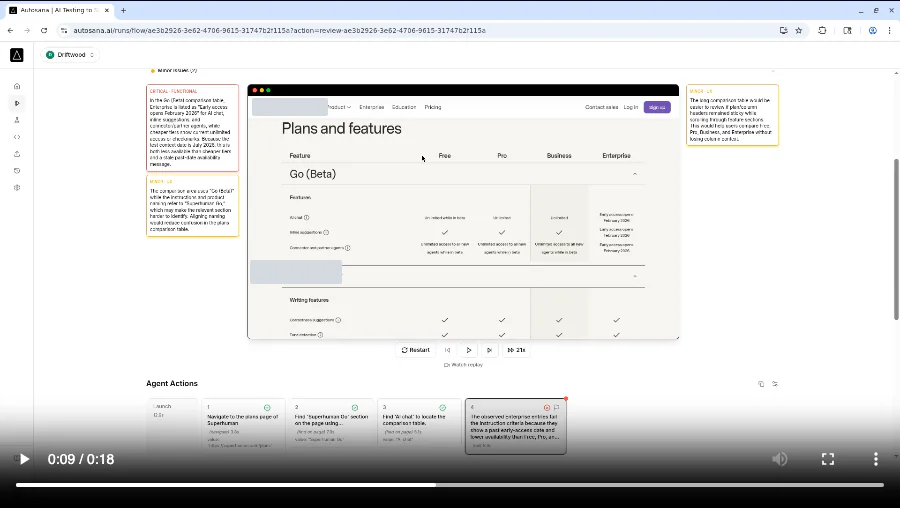
driftwood built this demo
Jul 10 · 12 hours later
send me a blurb + demos to and I'll forward to my team - best
Call booked · Jul 12
The right window is a real send from the Autosana week; identities redacted.
By hand. You can also run proof-of-work outreach by hand: audit a prospect's public signup flow and send what you found, or build a small working example against their API. It works. The cost is time, and the arithmetic of that time is the founder-led sales page.
Realistic funnel expectations
Plan with public numbers, not with a vendor's case studies.
The spread. The short version, with named sources and links on the cold outbound benchmarks page: at average quality and at scale, cold email replies now measure under 1% (Belkins' 2026 study of 7.5 million sends measured 0.45%). Small, carefully targeted, heavily personalized campaigns still measure between 5% and 18% in the public studies.
Average reply rate at scale
0.45%
Advanced personalization
17-18%
Belkins measured the average across 7.5 million emails sent in 2025; Woodpecker's data shows advanced personalization replying at roughly 17-18% against 7-9% without. Both studies, with the rest, are on the cold outbound benchmarks page.
LinkedIn. Connection accepts average roughly 19-30%, and message replies run about double cold email replies in the same datasets.
The founder-run plan. A realistic founder-run plan looks like this: 50 to 100 well-researched sends a week, a reply rate in the mid single digits if the list and the message are good, and one or two meetings a week from it. The full arithmetic, including where the hours run out, is the funnel table on the founder-led sales page.
If your numbers sit far below these, start with the diagnostic order on the benchmarks page, not with the copy.
Common questions
The questions founders ask about the channel itself.
Product questions about driftwood are on the FAQ.
How do you do B2B SaaS outreach?
In this order: define an ICP narrow enough to change the message, build a verified list and keep bounces under 2%, fix deliverability before touching copy, write short messages that prove you looked at the specific company, follow up two or three times with something new each time, and stop after four to six touches. The common failure is inverting the order and polishing copy on top of a bad list.
What is a good reply rate for B2B SaaS cold email?
Sopro's State of Prospecting 2026 puts most campaigns between 1% and 5%, and Instantly's 2026 benchmark guide calls 5-10% good and 10-15% excellent. At scale and average quality, measured replies fall under 1%. If you are below 1%, check bounce rate and deliverability before the copy. The full set of studies is on the cold outbound benchmarks page.
Does cold outreach still work for B2B SaaS in 2026?
Yes, with a widening spread. The average keeps falling as AI-written volume grows: Belkins measured 0.45% average replies across 7.5 million emails sent in 2025. The top end holds: Woodpecker's data shows advanced personalization replying at roughly 17-18% against 7-9% without. The channel rewards messages that show real work and punishes everything else a little harder each year.
Should you use email or LinkedIn for B2B SaaS outreach?
Both, from your own accounts. In the public platform datasets, LinkedIn message replies run about double cold email replies in the same studies, and connection accepts average roughly 19-30%. Email scales further and is easier to run deliverability checks on. For founder and executive targets, a LinkedIn message from a real profile tends to get read; for volume and threaded follow-ups, email is the workhorse. Sequence them rather than choosing one.
How do you personalize B2B SaaS outreach without sounding automated?
Treat personalization as proof of attention, not a merge token. Naming the company or the funding round is what automated sequences already do. Reference something that took effort to find: a product detail, a docs page, a hiring pattern, a bug. The measured gap is large: roughly 17-18% replies with advanced personalization against 7-9% without, in Woodpecker's data. The strongest form is proof of work, where the message carries something actually built for that prospect; that is demo-led outbound.
How many cold emails should a SaaS founder send per week?
As many as you can research properly, which is fewer than most plans assume. At about 30 minutes per prospect for real research and writing, two focused hours a day is about 20 prospects a week. Raising volume by cutting research usually lowers replies faster than it raises sends. The calendar math, and the options when it stops scaling, are on the founder-led sales page.
Do you need an AI SDR tool to do B2B SaaS outreach?
No. The first hundred sends teach you your ICP and your message, and a founder can run those by hand with a spreadsheet, a verified list, and their own inbox. Tools matter once the motion works and the constraint is hours. When you compare them, the real differences are autonomy model and message quality, not send volume; we keep a comparison of AI SDR tools, including where the fully autonomous ones fit.
See a demo built for your business
If your outreach reads like everyone else's, the fix is proof of work. Twenty minutes, and we will show you a demo built on your product.
Book a demo