Artisan alternatives
By the driftwood team · July 2026
Updated July 2026. Pricing and features get a monthly fact-check.
The disclosure, first. We build driftwood
(
driftwood.sh), and it is one of the six
alternatives below. Artisan is also our closest competitor in philosophy,
which is exactly why we have tried to be fair to it. Every entry says who
should pick that tool, and the last section covers when Artisan is the
right choice, including over us.
Most people searching for Artisan alternatives, or Artisan AI
alternatives, are in one of three situations: Ava booked meetings that
went nowhere, the messages read like AI and replies stayed low, or the
pricing conversation for real volume landed somewhere very different
from the $250 entry point. Those are different problems with different
answers, so this page starts with what Artisan actually is and where it
genuinely wins. For the whole AI SDR category, we keep
a separate ranked comparison.
What Artisan is, and what it is genuinely good at
Artisan sells Ava, an AI BDR, as the flagship of a larger pitch about AI
employees that take over whole roles. Since the Ava 2.0 relaunch in May
2026, the product is self-serve: you can sign up without a sales call,
onboard in minutes, and entry pricing dropped from $2,500 to $250 a month,
metered in credits. By default Ava runs the whole motion autonomously. It
sources prospects from a database Artisan says covers more than 250
million B2B contacts, enriches them from 22+ data sources, writes and
sends sequences, handles the replies, and books the meetings. Artisan says
teams that prefer manual review at any stage can turn it on.
The platform around the agent is genuinely complete: intent signals such
as funding rounds, leadership hires, and website visitors, automated
testing of dozens of message variations at once, a managed deliverability
layer with warmup, mailbox health checks, and dynamic send limits, a
dialer that queues calls for human reps, and CRM sync with HubSpot and
Salesforce. Above the self-serve tiers, Artisan's published pricing page
lists quote-based Team (around 2,500 leads contacted a month), Scale
(around 6,000), and Enterprise plans, priced through sales with CSM
support included, as of July 2026.
What it is genuinely good at: Ava is the most polished product in the
autonomous AI BDR category, and the all-in-one claim is real. Data,
sequencing, deliverability, reply handling, and booking live in one tool,
with nothing else to assemble. The $250 self-serve tier is the cheapest
credible way to try a fully autonomous outbound motion anywhere in the
category, and Artisan has public case studies with recognizable names
such as SaaStr, SumUp, and CookUnity. If you want outbound fully
delegated to an agent, Ava is the reference product to evaluate first.

Where Artisan falls short, and for whom
Autonomy by default cuts both ways
Since 2.0, Ava closes the loop on its own: replies get answered and
meetings get booked without a human in the flow unless you enable
review. When the targeting and copy fit your market, that is the whole
appeal. When the agent misreads a niche ICP, it sends at volume in your
company's name before you see the problem. Manual review exists, but it
is the exception path; the product is designed around the hand-off.
Reply quality drops on narrow ICPs
Artisan's reviews are unusually polarized: clusters of five-star and
one-star ratings with little in between. The recurring negative theme
through 2026, on Reddit and in review roundups, is messages that read as
machine-written and generic for niche or technical audiences, including
reports of sends in the thousands with no replies. The success stories
skew toward broad, horizontal offers where volume personalization is
enough.
Booked meetings are not qualified pipeline
Even users who got meetings from Ava report, in some 2026 reviews, that
the leads were poorly qualified and the conversations did not convert.
An autonomous agent graded on meetings booked will optimize for the
meeting. If your sales cycle punishes bad-fit calls, count qualified
opportunities, not calendar events, when you evaluate it.
The real price takes a sales call
The $250 entry is real, but credits meter every enrichment and send,
2026 reviews describe the named self-serve tiers as annually billed, and
the published pricing page lists no dollar amounts at all for the Team,
Scale, and Enterprise volume plans. Reviews from the sales-led era also
flag annual contracts and cancellation friction. None of that is
disqualifying; it does mean you should price your actual volume and
read the terms before committing.
Volume personalization has a ceiling
Ava personalizes with researched facts and tests message variations
automatically, and it does that well. But the output is still the same
class of email your prospects already receive from every AI SDR, and
buyers have learned to recognize it. If your market is ignoring
AI-personalized email, an agent that sends more of it will not change
your reply rate. That is a limit of the approach, not of Artisan's
execution of it.
Six real alternatives
1
Artisan and driftwood make the same bet: an agent should run the
outbound motion, not just assist it. They split on three defaults.
Ava is autonomous by default; driftwood has a human approve every
send, by design. Ava manages the sending layer and answers replies
for you; driftwood sends from your own LinkedIn or email account,
and you stay in the conversation. And where Ava personalizes
messages at volume, driftwood runs
demo-led outbound: every message
carries a working demo of your product, built for the specific
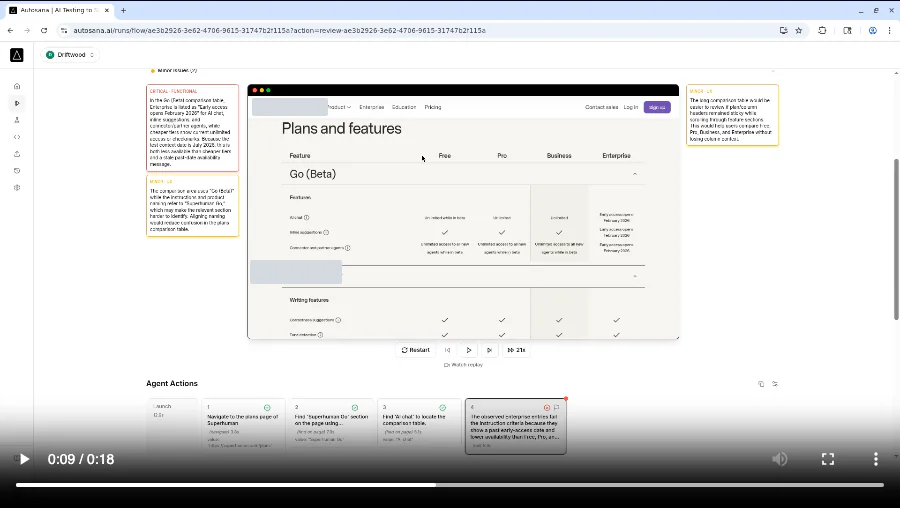
prospect receiving it. On the same lead list, replies went from
under 1% to over 14% in week one at
Autosana (YC S25).
The honest fit: driftwood is early, and it trades volume for depth.
If you want a full hand-off at thousands of touches a month, Artisan
is the better shape; driftwood is for founders who want proof in
every message and a hand on every send.
Best for: founders and lean
teams selling a product that demos well, who want the agent's work
shown to a human before it ships.
2
11x is the closest like-for-like swap: digital workers, with Alice
the AI SDR running sourcing, multi-channel sequencing, and follow-up
with little day-to-day steering, and Julian covering the phone. The
positioning leans enterprise, with no public pricing, where Artisan
now starts self-serve. If you like Artisan's bet but want to
compare it against the other flagship of the same category, this is
the evaluation to run.
Best for: larger sales orgs
replacing or avoiding outbound headcount at scale.
3
Amplemarket is the middle path between Ava's autonomy and running
everything yourself: an all-in-one sales platform with contact
data, engagement, deliverability tooling, and an AI copilot called
Duo threaded through the workflow. Your reps stay in charge of the
motion; the AI accelerates it. The right direction if Artisan's
appeal was consolidation but the autonomy is what worried you.
Best for: sales teams that
want one vendor for the outbound stack with humans still running
it.
4
Apollo is the budget version of the same consolidation: a large B2B
database with sequencing, a dialer, and light CRM bundled per seat,
with a free tier and paid plans from $49 per user per month billed
annually as of July 2026. There is no autonomous agent running your
motion; there is also no agent to babysit. You trade Ava's
delegation for tools you operate at a fraction of the cost.
Best for: teams that want
data and sending in one place and are happy to run the motion
themselves.
5
If what you actually wanted from Artisan was volume email, Instantly
sells the infrastructure directly: sending plans from $47 a month as
of July 2026 with unlimited mailboxes and warmup included, plus a
lead database and AI agents as separate add-ons. You give up the
autonomous agent and take on the operating work, at a much lower
price per send. We compared
Instantly alternatives
separately.
Best for: teams with a
proven high-volume email motion that need cheap sending
infrastructure, not an agent.
6
Clay is the opposite trade from delegation: a data workbench where
you build the targeting and personalization logic yourself, with
waterfall enrichment across more than a hundred providers and AI
research columns, from $185 a month for Launch as of July 2026. It
needs an operator, and it sends nothing on its own, which is
precisely the point if Ava's judgment was your problem. We compared
Clay alternatives separately.
Best for: teams with a
RevOps or GTM engineering owner who want control over targeting
rather than delegation.
When Artisan is the right choice
Artisan is the right choice when you genuinely want outbound off your
plate and your market can absorb the motion: a broad addressable market,
a horizontal offer that does not need deep technical context, and comfort
with an agent sending in your name without review. Within the autonomous
AI BDR category it is the natural first evaluation: the product is more
polished than its direct competitors, the platform really is all-in-one,
and the $250 self-serve tier means you can test the whole premise for the
cost of a dinner out, which nothing else in the category matches. That
includes over us: if you want autonomy and volume rather than review and
depth, pick Artisan over driftwood. The honest dividing line: delegate
the motion to an agent, buy Artisan or 11x. Keep humans running it, buy
Amplemarket, Apollo, Instantly, or Clay. Run an agent with a human hand
on every send and proof in every message, that is what driftwood is for.
FAQ
What does Artisan cost in 2026?
As of July 2026, self-serve entry pricing starts at $250 a month, cut
from $2,500 when Ava 2.0 launched in May 2026, with usage metered in
credits. Reviews of the self-serve tiers describe a free plan, an entry
tier around $250 a month, and a mid tier around $600 a month, both on
annual billing. The published pricing page lists quote-based Team,
Scale, and Enterprise plans with no public dollar amounts, so real
volume is priced through sales. Check artisan.co for current numbers.
How autonomous is Ava?
Fully autonomous by default since the 2.0 relaunch: prospecting,
sequencing, reply handling, and meeting booking all run without a human
in the flow, and Artisan says manual review can be enabled at any
stage. driftwood makes the opposite default: a human approves every
send before it goes out.
What is the closest direct alternative to Artisan?
11x's Alice: another autonomous AI SDR running the same end-to-end
motion, with an enterprise lean and no public pricing. Amplemarket and
Apollo cover similar ground with humans in charge. driftwood makes the
same agent bet with the opposite defaults, which we compare in
our AI SDR tools ranking.
Will an autonomous AI BDR fix a low reply rate?
Usually not on its own. If prospects are ignoring AI-personalized
email, an agent that sends more of it changes little; the lever is what
the message carries. The case for changing that is laid out in
demo-led outbound, and the result at
one company is written up in
the Autosana story: replies went from
under 1% to over 14% in week one at Autosana (YC S25).
See a demo built for your business
Twenty minutes. We will show you what your prospects would see.
Book a demo