What is an AI SDR?
Updated July 2026. Figures checked 2026-07-21; this page gets a monthly fact-check.
An AI SDR is software that does the outbound work of a sales development representative: researching prospects, writing outreach, sending it, and following up on replies. The tools split into two kinds: autonomous AI SDRs, which send on their own, and assisted AI SDRs, where a human approves every send before it goes out. This page covers what the tools actually do well and badly in 2026, and how to evaluate one for your stage.
What an AI SDR actually does
The four parts of the job, and the two questions that separate tools.
The job. SDR stands for sales development representative: the person at the top of a sales team whose job is to find prospects and start conversations, which someone else then closes. An AI SDR is software doing that job. It breaks into four parts, and most tools cover some or all of them.
Research. Reading what is public about the person and the company, and deciding whether and why to reach out.
Drafting. Writing the message for that specific prospect, usually for email or LinkedIn.
Sending. Scheduling sends, managing deliverability, and rotating inboxes where the tool uses its own accounts.
Follow-up. Bumping non-responders, spotting replies, and handing real conversations to a person.
Where tools differ. Tools differ less on this list than on two other questions: what the message actually carries, and whether a human approves each send before it goes out. The first is where the reply numbers live; the second splits the category into the two kinds further down this page.
One category, several names
AI sales agent, AI sales rep, AI BDR: the same software.
The labels. AI sales agent and AI sales rep describe the same tools. Agent usually signals software that plans and acts in a loop rather than running a fixed sequence, and some vendors stretch the label to cover inbound and full-cycle selling, but for cold outbound the products are the same category.
AI BDR is fading. AI BDR meant the same thing too and is falling out of use: in Google's Keyword Planner data pulled July 2026, US searches for "ai bdr" are down about 90% year over year while "ai sdr" holds steady. Whatever the label on the website, you are evaluating the same kind of software, and the same four questions later on this page apply.
What AI SDRs do well and badly today
Coverage is solved. The message is not.
What they do well. Coverage and consistency. An agent can research more prospects in an evening than a rep covers in a month, it never forgets a follow-up, it works at whatever hour the prospect's timezone wakes up, and its cost per message rounds to zero.
The research is real. Reading a company's site, docs, job posts, and news and producing an accurate picture is something current models do reliably.
What they do badly. The message. Most tools in the category compete on volume, and their personalization is copy-deep: a merge tag fills in the first name, a scraped detail supplies the opener, a language model restates your homepage in a friendly tone.
Prospects have caught on. It costs nothing to produce and it reads that way, and prospects now pattern-match the style and delete it unread. The public numbers bear this out.
Cold email replies at average quality, at scale
under 1%
Small, heavily personalized campaigns
5% to 18%
The at-scale figure measured 0.45% across 7.5 million emails in one 2026 study; every number has a named source and year on the cold outbound benchmarks page.
The spread is the game. The gap between those two numbers is the whole category argument, and volume tools sit on the wrong side of it. More sends is not the same thing as more replies.
The costs off the dashboard. Burned sending domains, mail that quietly lands in spam, and lead lists that stop being usable because everyone on them has already deleted three of your sequences.
Autonomous vs assisted AI SDRs
The most useful split in the category is who approves the send. Vendor pages rarely put it in those words, so here are the two kinds plainly.
Autonomous. An autonomous AI SDR sources prospects, writes the messages, and sends them on its own. You set the targeting and the playbook up front and review results after the fact. The bet is volume: more prospects touched per dollar than any human team could match. 11x's Alice, Artisan's Ava, and AiSDR work this way.
Assisted. An assisted AI SDR does the same work, the research, the drafting, the follow-up, but a human approves every send before it goes out. The bet is quality: nothing reaches a prospect unread, so the agent can take bigger swings with each message, and a bad one gets caught in review instead of in a prospect's inbox. Vendors and buyers also call this an AI SDR with human approval, or a human-in-the-loop AI SDR; the labels describe the same design. driftwood (driftwood.sh) is an assisted AI SDR, so read this page knowing which side we sit on.
Which kind fits. It depends on what a mistake costs you. A fifty-person sales org running a proven playbook can absorb a clumsy message; the volume pays for it.
The founder case. A founder sending from their own LinkedIn and email to a market they will live in for years cannot; one embarrassing message to a prospect who knows your investors costs more than ten messages never sent. That is why stage, not feature lists, should drive the choice, which is where evaluation starts.
How to evaluate an AI SDR
Four questions separate the tools faster than any demo call.
1. Start from your stage
Before product-market fit, your message changes weekly, because you are still learning what lands. An autonomous agent scales a pitch you have not validated yet; reviewing every send is not overhead at that stage, it is how you learn.
If founder-led sales is working but eating your week, that is the moment for an agent that drafts while you keep judgment. Once a playbook is proven and the math is about coverage, autonomy buys real leverage.
2. Ask who approves the send
One direct question: does anything reach a prospect without a human reading it first? If the website will not answer it plainly, that is your answer.
Approve-before-send, sometimes described as human-in-the-loop, costs you minutes a day and is the difference between an agent that works for you and one that speaks as you unsupervised.
3. Price the all-in cost, not the subscription
The subscription is the start. Add data and enrichment credits where they are metered, the extra mailboxes, domains, and warmup tools where the vendor sends from its own infrastructure, and your own time reviewing or cleaning up whatever the tool gets wrong.
Published entry prices in the category run from $250 a month (Artisan, self-serve) to around $900 a month (AiSDR); the enterprise agents, 11x among them, are custom quoted and publish no pricing. driftwood publishes its range: $1,000 to $5,000 a month depending on send volume and channels, with details on the FAQ page. Whichever tool you pick, get the all-in number in writing before you compare.
4. Ask whose accounts it sends from
Two setups exist. Tools that send from mailboxes and domains stood up for the campaign protect your main domain, but the message arrives from an address the prospect has never seen and replies land in a tool inbox. Tools that send from your own accounts put your name and reputation behind every message, which is stronger, and is exactly why each of those messages deserves review before it goes.
Be wary of the combination of high volume, your accounts, and no approval step: that is your reputation spent at machine speed.
For a tool-by-tool pass over the current field with these axes applied, driftwood included and ranked with a disclosure, see the comparison of AI SDR tools.
Where driftwood fits
Demo-led outbound, the week that measured it, and who it is for.
What driftwood is. driftwood runs demo-led outbound: cold outreach where every message carries a working demo of your product, built for the specific prospect receiving it. The prospect sees your product working on their problem before deciding whether to reply.
How it runs. The agent researches the prospect, builds the demo, and drafts the message. Sends go out from your own LinkedIn or email account, and a human approves each one before it leaves, which is what puts driftwood on the assisted side of the split above.
what a volume agent sends
quick question
Hey ,
Hope you're doing well! Huge fan of what you're building, truly impressive momentum.
I'm with an AI-powered QA platform, the all-in-one way to ship faster with confidence. Teams like yours are seeing huge results and we'd love to show you how.
A few things teams love:
- Cut regression time by up to 90%
- Seamless integration with your existing stack
- Enterprise-grade security (SOC 2 Type II)
Any chance you have 15 minutes this week? You can grab time here.
Best,
SDR @
P.S. Happy to send over a case study if that's easier!
Left on opened.
what driftwood sent
4 months of outreach, no reply
Jul 9

hey , found a bug on . our agents caught your pricing page still promising early access for features lower tiers already have…
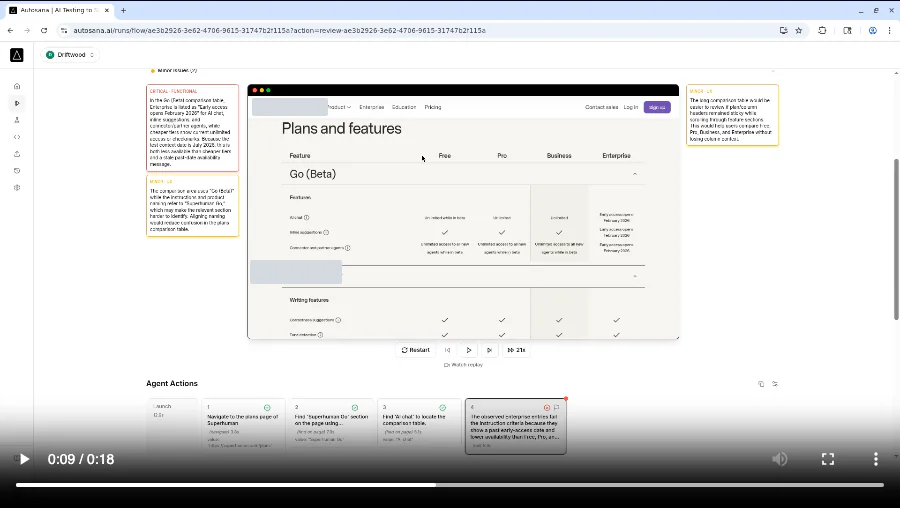
driftwood built this demo
Jul 10 · 12 hours later
send me a blurb + demos to and I'll forward to my team - best
Call booked · Jul 12
The right window is a real send from the Autosana week; identities redacted.
Reply rate before
under 1%
Reply rate, week one
over 14%
On the same lead list, replies went from under 1% to over 14% in week one at Autosana (YC S25), including founders who had ignored more than four months of prior outreach.
Read it with the caveats. That is one company, one list, one week, and driftwood's founder worked at Autosana before building driftwood. The methodology is published on the benchmarks page and the longer writeup is the Autosana case study.
Where we are. driftwood is early: one published case study, a small set of customers, and a founder who still runs onboarding himself. If you want thousands of autonomous touches a month, one of the autonomous agents on the comparison page will serve you better. If you want every prospect to see your product working on their problem before they decide whether to reply, that is what driftwood is for.
FAQ
Eight short answers.
What is an AI SDR?
The definition. An AI SDR is software that does a sales development rep's outbound job: it researches prospects, writes and sends outreach, and follows up on replies. The tools split into autonomous AI SDRs, which send on their own, and assisted AI SDRs, where a human approves every send before it goes out.
What is an AI sales agent? Is it different from an AI SDR?
In practice, the same category. AI sales agent is the broader label: some vendors use it to cover inbound and full-cycle selling, and agent usually signals software that plans and acts in a loop rather than running a fixed sequence. For cold outbound, AI SDR and AI sales agent describe the same tools.
What is the difference between an autonomous and an assisted AI SDR?
Who approves the send. An autonomous AI SDR sources prospects, writes the messages, and sends them on its own; you set targeting up front and review results after the fact. An assisted AI SDR does the same research, drafting, and follow-up, but a human approves every send before it goes out.
The tell. Autonomous optimizes for volume, assisted for quality per message. Most vendor pages do not say which kind they are selling, so ask directly: does anything reach a prospect without a human reading it first?
Do AI SDRs actually work?
It depends which number you want. They reliably produce more sends per dollar. But the public studies collected on our benchmarks page show average cold email replies under 1% of sends at scale, so more generic sends mostly produce more ignored emails.
What moves the number. Replies change when the message carries something specific the prospect can verify. Our own week-one numbers at Autosana, in the driftwood section above, point the same way: every message carried a working demo of the product.
How much does an AI SDR cost?
From about $250 a month up. Published entry prices run from about $250 a month (Artisan, self-serve) to around $900 a month (AiSDR); enterprise agents such as 11x are custom quoted and do not publish pricing.
The subscription is not the whole number. Add data credits, extra mailboxes and domains where the tool sends from its own infrastructure, and your own review time. driftwood publishes its range: $1,000 to $5,000 a month depending on send volume and channels.
AI SDR vs human SDR: what is the difference?
Cost and judgment. Public salary data puts the median US SDR at $60,000 base and $85,000 on-target earnings (RepVue, March 2026), before benefits, tools, data, and management time. An AI SDR costs a fraction of that and covers more prospects, but it has no judgment of its own: left unsupervised, it produces generic outreach at scale.
The working setups. The ones that work keep a human in the loop, either a rep using the software or a founder approving an agent's sends. If the real question is whether to hire at all, the founder-led sales page walks through that decision.
Can an AI SDR send from my own email and LinkedIn accounts?
Some can. Many volume tools send from mailboxes and domains stood up for the campaign, which protects your main domain but means messages arrive from an address the prospect has never seen and replies land in a tool inbox. Tools that send from your own accounts put your name behind every message. driftwood works this way: the demo-led messages it builds go out from your own LinkedIn and email, and a human approves each send.
What is the best AI SDR tool?
There is no single answer. It depends on your stage, the autonomy level you want, the all-in cost, and whose accounts it sends from. We keep a comparison of the current tools, driftwood included and ranked with a disclosure, on the best AI SDR tools page.
See a demo built for your business
Twenty minutes. We will show you what your prospects would see.
Book a demo